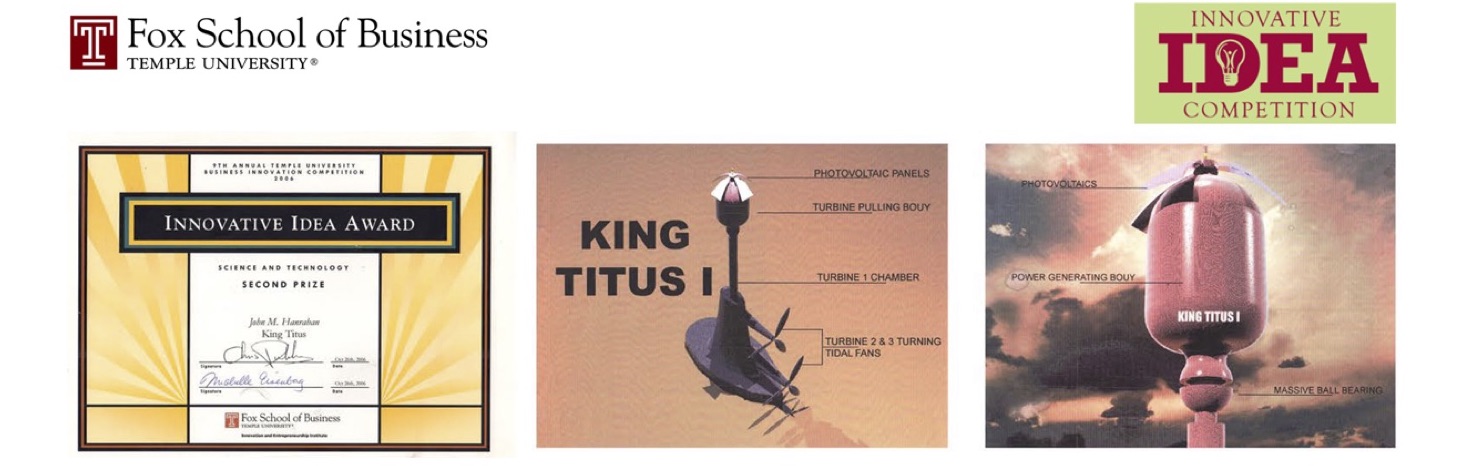
Award and Recognition
John Hanrahan won second place in an innovation competition for inventing and proposing the King Titus renewable energy platform. The competition focused on identifying breakthrough ideas capable of advancing global infrastructure and energy systems. King Titus was recognized for its originality, engineering ambition, and forward-thinking integration of multiple renewable energy sources into a single unified platform.
Concept and Innovation
The primary objective of King Titus was to explore a new type of multi-source renewable energy system capable of harvesting energy from solar radiation, tidal motion, and ocean wave dynamics simultaneously. By combining multiple forms of renewable generation into a single offshore structure, the system was designed to significantly increase efficiency, reliability, and scalability compared to single-source energy platforms.
At the time of the invention, very few projects globally were even approaching the integration of multiple renewable sources in a single architecture. Extensive research conducted during development did not identify any existing platforms combining solar and wave energy in this manner, making King Titus a uniquely original and forward-looking design.
System Design
The King Titus platform was conceived as a floating offshore structure capable of supporting solar arrays above the water surface while simultaneously utilizing submerged turbines to capture tidal and wave motion. The modular architecture allowed for expansion, adaptation to varying ocean environments, and integration into future energy networks.
This approach allowed the system to operate continuously, generating energy across varying environmental conditions and reducing the intermittency challenges typically associated with renewable energy.
Purpose and Impact
King Titus was designed not only as an engineering solution, but as an exploration into the future of sustainable infrastructure. The project demonstrated how art, design, and engineering could intersect to create visionary systems capable of addressing global environmental challenges.
The invention represents an early exploration into integrated renewable energy platforms and reflects a broader commitment to innovation, sustainability, and interdisciplinary design.